Everyone has heard of a seed bank, a kind of external hard drive that backs up our rich genetic diversity. They’re great resources, and may become incredibly important in the decades of changing climate to come. Yet they’re incomplete. Not every plant reproduces reliably by seed. Plant the seed from a Granny Smith apple, for example, and you won’t get a Granny Smith apple tree. They’re like humans this way—we don’t replicate perfect little copies of ourselves, either. Plants of this type need to be cloned. Hops are like apple trees, and you reproduce a variety by planting a rhizome, which looks like a root but is actually a subterranean stem.
A Living Museum
Lots of plants are heterozygous—they produce offspring that differs from the parent—so preserving their seeds is not much use. Instead, ARS maintains sites across the country that keep a living inventory of plants rather than seeds—“clonal repositories.” The sites maintain plants that grow in the regions, so for example, the Hawaiian site preserves pineapple, breadfruit, papaya, rambutan, guava, and cacao. Iowa, on the other hand, specializes in things like corn, millet, sunflower, and flax. In Corvallis, Oregon, the inventory includes pears, hazelnuts, mint, berries—and hops.
That’s where you’ll find Dr. Nahla Bassi, who oversees the collection and tests unknown varieties that come into the laboratory. lCorvallis maintains over three hundred separate varieties of hops, many that we know, some wild varieties, some obscure varieties, and some ornamental varieties. They even maintain a greenhouse where hops have been infected with various common viruses. Beyond taking care of these plants, Dr. Bassil and her team do research—including looking at markers on hops to determine what kind they are.
Fingerprinting a Hop
So what happens when a researcher sends Dr. Bassil a hop? The process starts with a piece of the plant. “You want the tissue of the mother plant, not the gamete [like a seed]” she began explaining. “Young leaf tissue has less secondary metabolites, and the DNA is cleaner.” Dr. Bassil takes a small bit of leaf and grinds it up until it becomes powdery. She uses a “buffer”—a chemical compound—to separate the DNA from the plant, and then unzips the paired DNA strands under high temperature with an enzyme and more chemicals. It will “amplify” certain sections of the DNA sequence.
The upshot in this process is sampling just a part of the DNA, rather than looking at every gene. Those sections are known as “markers,” and that’s how they distinguish among hop plants. The OSU researchers select regions that will help them tell the hops apart. “The markers are regions in the chromosomes that are very variable between different individuals,” Dr bassil said. Some plants are more alike, some different, and require fewer or more regions.
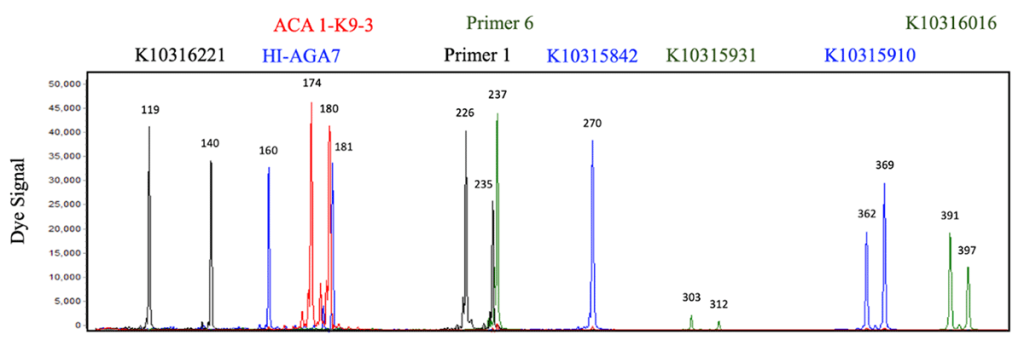
She continued. “On hop DNA, nine different regions are amplified. Sometimes plants have the same fingerprint in one region, so you want more regions so you can distinguish the different cultivars. You’re targeting a specific region that is highly variable between individuals. With humans we used to start with 13 different regions, and they’ve added more. Depending on how variable the crop or species is, then you may need more. If it’s not very variable, you need more. We use 14 markers in hazelnuts.”
In the end, they produce an electropherogram, or visual graph of the different markers, and that distinguishes them from other hops, and also allows them to group the specimen with similar hops, like cousins in a family. This is Cascade:
The Collection
As they approach the repository in Corvallis, sharp-eyed visitors might notice an orchard before they reach the parking lot. Those are their pear specimens. You won’t see trellises for hops, though—they keep those inside greenhouses (or technically “screenhouses”).The facility has recently been reonovated, and the hops’ cozy homes are filled with pots and bines at different stages climbing out of them. This is the only home the hops will know. They keep them in a screenhouse to protect them from pests, disease, and cross-fertilization.
Beyond the work of fingerprinting, Dr Bassil’s laboratory works on other projects. One of the most valuable may be work done by Dr. Shaun Clare, who has developed a new technique for distinguishing between male and female plants. It’s curious that they haven’t found a specific gene for determining sex—but they have found associated genes that are correct 95% of the time. “The way Dr. Clare developed it is by associating a variation with the trait,” Dr. Bassil said. “That association didn’t get us to the gene itself, it got us very close to it. That’s how markers are, you find an association. That’s what Dr. Clare did: he developed a tool to detect that difference between the male and female.” This will be very valuable for breeders, who only want to grow female plants for commercial production (males are too seedy). It should save them a lot of time weeding the males out of their populations. A paper on the technique was just submitted.
Dr. Lauri Reinhold and Gabriel Flores manage the hop plants. “We’re simply preserving genetics,” Flores said. “If we have things flowering and coning and breeding with each other, then we’ll lose the integrity of our collection. It’s difficult. All these hops will grow laterals and they want to climb onto their neighbors, so it gets a little dicey. They can grow six inches a day—sometimes more. You’ll leave on Friday and you’ll come back on Monday and everything’s up here in the rafters. They take quite a bit of work.”
Since these plants aren’t grown to provide tasty hops for our IPAs, the folks tending them have a different relationship to their charges than a brewer might. Grouped roughly by region, some of the plants begin their spring climb in March, while others only have tiny shoots emerging. One plant has blue leaves. Others have unusually-shaped leaves with a single main lobe, unlike the characteristic three- or five-lobed leaves seen in the fields. They talked about which plants were aggressive, and which were more demure. They even described their behavior, as if they had personalities.
At one point, Flores referenced their latest addition, the Monocacy hop, found growing wild in Maryland. They continue to add to the collection, even going on expeditions for wild hops where they get reports of potential varieties growing wild. One group they don’t maintain, however, are proprietary hops. Perhaps once those fall into the public domain they’ll make their way here. For now, it’s all public commercial and wild varieties.
If there’s ever a problem with a commercial crop, Oregon State will be protecting the genome. As breeders look to develop heat- and drought-resistant varieties, they’ll look at the plants contained in Corvallis. It is a wonderfully valuable resource, one that helps shape the way our beers taste, even if we have no idea it exists. That’s all right, the researchers are happy out of the limeline, nurturing and testing their little green friends.