The Pacific Northwest is a massive region, larger than the United Kingdom. The Willamette Valley, where Oregon’s hops are grown, is 200 miles from Washington’s hop-growing Yakima Valley, and 400 miles from the major hop-growing region in the Treasure Valley of Southern Idaho. More significantly, the Cascade Range runs vertically through Oregon and Washington and creates remarkably different ecosystems. On the west side of the mountains it’s wet and cloudy, and on the east dry and sunny. Much of the east side gets less than ten inches of rain a year, while parts of the west side are temperate rainforests receiving 80 inches or more a year.
Climate
The Willamette Valley (pronounced “wuh LAM it”) has annual rainfall of around 40 inches a year (102 cm). It’s near sea level, and winter lows are on average warmer than freezing, while summer highs are around 77 degrees (25 C). In comparison, Yakima and Southern Idaho are in arid high deserts; Yakima lies about a thousand feet above sea level, Idaho’s hop region another thousand feet higher than that. Neither gets ten inches of rain a year (25 cm). Summer highs average 87 degrees (31 C), and lows in both places are below freezing half the year. The American West is dry everywhere in the summer—even Oregon has clear skies most days. Still, Yakima gets less than an inch of rain June through August, while Silverton (to choose a town near the Oregon hop fields) gets 3.6 inches (9 cm).
And that’s just the climate. Soil, so important to plant expression, is quite different in Yakima and the Willamette Valley. The soil plants grow in is remarkably complex, and includes what the stuff is made of, how much drainage it affords, its level of acidity/alkalinity, its temperature, and on and on. The latitudes aren’t quite the same in the three places, nor are the winds or the local fauna and flora (especially nearby fields). Fertile western valleys and dry high desert are both within the Pacific Northwest, yet they couldn’t be more different. So how does all that affect the flavor and aroma of the hops grown there?
Hop Varieties
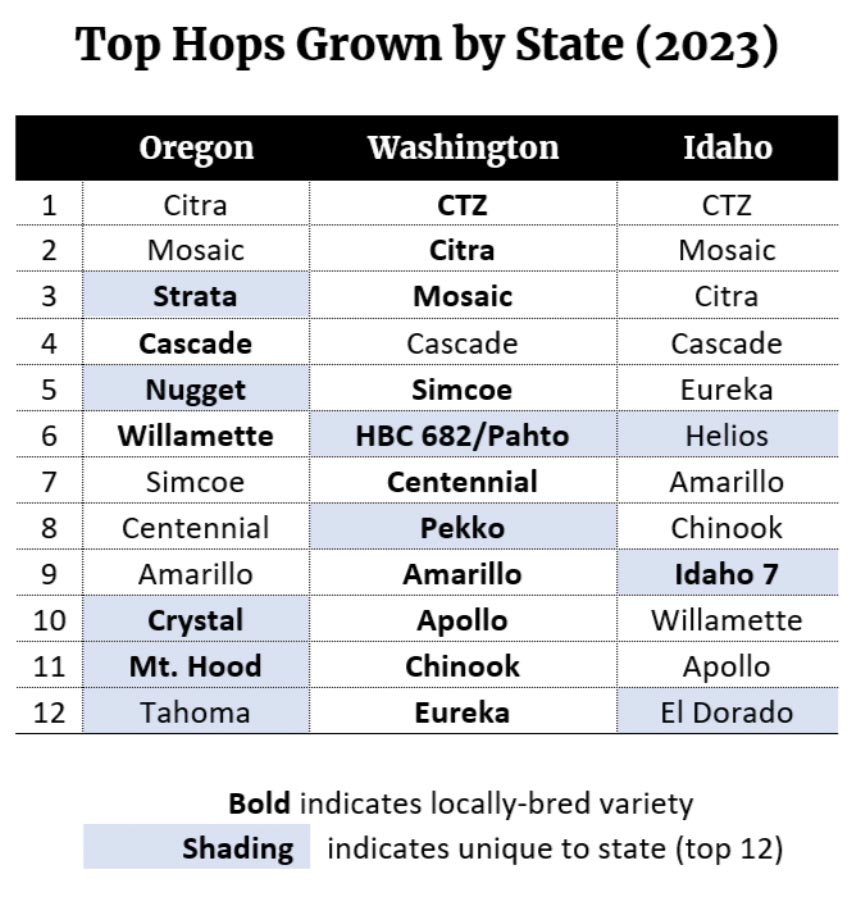
One way to tell is by looking at the hops that grow well in each region. If the hop expressions were really different region to region, we’d expect different hops to grow where they’re best-suited—and that’s exactly what we find. Below are the tables, with numbers taken from the Hop Growers of America dataset. The blue shading indicates varieties that only appear among the top 12 varieties by pounds in that state.* The bolded varieties were developed in the state in which they’re grown. As you can see, all but one of the most-grown Washington hops were developed there, and half of Oregon’s most-grown hops were bred there. Idaho doesn’t have a lot of breeding, but hops developed there are grown there—at least for a time.

The Hops Not Grown
These graphs show which hops are grown in each state, and by implication, they show which aren’t grown there. For example, Nugget, a very big hop in Oregon, is basically not grown in Washington or Idaho. Pekko and HBC 682 are not grown in Oregon or Idaho. So not only are these hops grown in different proportions in each state, but in key cases they’re state-specific.
Oregon’s Varieties
What really leaps out in these graphs is the number of older American hops still grown in Oregon: Cascade (1971), Crystal (1983), Mt. Hood (1989), and Willamette (1976). Those also happen to all be hops bred in Oregon. It’s not just the varieties, either—these hops are different in type as well. They’re relatively lower in alpha acids, and tend toward the herbal/spicy spectrum rather than the tropical. They’re more “European.” One could even throw Oregon-bred Nugget (1983) in that group if you overlook its tremendous levels of alpha acids. It isn’t an artifact of one year, either—in 2018, the pattern held, though the hop mix was different. In 2018, the more “European” varieties grown in Oregon were Cascade, Liberty, Willamette, Crystal, Mt. Hood, Sterling, and Nugget—and all of those were bred here.
So it’s no surprise that Oregon, with its more European-like climate, is better for brewing hops that are more European in character—that is, less punchy, tropical, and intense, and softer, and more herbal and woody/spicy.